
Reading Notes: Arthur Miller's Soil of Poetry
Or the paradox of being a child.

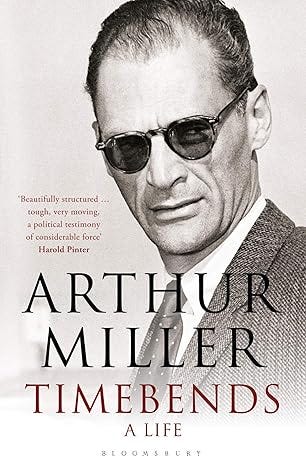
Arthur Miller opens Timebends (1987) with an idea that feels, at first, almost intuitive, but the more you sit with it, the more it unsettles what we think memory is doing.
He suggests (read the excerpt below) that childhood is not simply a prelude to understanding, but a fundamentally different way of knowing. When we are young, we are not yet equipped with the frameworks that make the adult world legible. We do not understand motive, history, or consequence in any structured way. What we experience instead are impressions; intense, immediate, and often incomplete.
Miller calls this “the view from the floor,” a phrase that captures both the physical and epistemological position of the child. It is a vantage point defined by proximity without comprehension. Things are seen and felt before they are understood. And because of that, they are misread—sometimes dramatically so.
But Miller resists the urge to correct those misreadings too quickly.
What he suggests, instead, is that these early misunderstandings are not incidental to the formation of the self, but central to it. They are not simply errors waiting to be revised by adulthood. They are, in many ways, the origin of perception itself. The child constructs meaning out of fragments, and those constructions carry an emotional intensity that later knowledge cannot fully undo.
This is where Miller’s insight becomes especially important for writers.
If these early perceptions are “wrong,” they are wrong in a way that is deeply generative. They are private, unshared, and resistant to external validation. No one else saw exactly what we saw or understood it in quite the same way. And because of that, those moments become uniquely ours. They form a kind of internal logic that does not need to align with reality in order to feel true.
That gap between what happened and what was felt to have happened is where imagination begins to take hold.
Writing, then, is not just an act of recollection. It is an act of return. It asks us to revisit those early, unsteady interpretations of the world and to take them seriously, even when we now “know better.” It asks us to resist flattening them into neat explanations shaped by hindsight.
And yet, there is tension here.
To grow up is, in part, to reinterpret the past. We come to understand the forces that were invisible to us as children like family dynamics, grief, addiction, power, silence. We begin to see how much we could not have known. And in doing so, there is a temptation to dismiss those earlier perceptions as naïve, to overwrite them with something more accurate, more adult.
But something is lost in that correction.
A child cannot name what is happening in a room, but they can feel it with remarkable precision. They register shifts in tone, in presence, in absence. They build meaning from what is available, even if that meaning is structurally unsound. What they produce is not factual truth, but experiential truth. That distinction matters.
Experiential truth is often where art begins.
Miller’s point is not that memory is a mistake. It is that memory is built from partial knowledge, and that partiality is not a weakness but a condition of creativity. The child’s world is not yet fixed. It allows for connections that an adult might dismiss, for interpretations that exceed what can be proven.
Some writers spend years trying to dismantle those early constructions, to arrive at something more stable, more “correct.” Others return to them, recognizing that within those initial misunderstandings is a kind of freedom or a way of seeing that has not yet been disciplined into coherence.
In childhood, we are most open to the world, we are also least able to interpret it. And yet, it may be that this is precisely where the work begins; not in clarity, but in the persistence of those first, uncertain meanings that refuse to disappear.
Excerpt:
“It is simply that the view from the floor, filled though it is with misunderstandings, is also the purest, the matrix whose content is so difficult to change later on. The impact of things seen and heard from the carpet is red-hot and returns with a far greater shock of truth when recalled because those visions are our very own, our private misunderstandings of reality shared by no one else, and are thus the soil of poetry, which is our freedom to alter mere facts. From misunderstandings, more than from anything dutifully learned out of respect for culture, the threads unwind that spin the uniqueness of each artist’s vision, promising implicitly to remake the world all new. Unknowingly, almost from the beginning, I have sought to reconstruct my life, becoming my brother from time to time, my father, my mother, putting on theirs and others’ forms and faces in order to test the view from angles other than my own. And incidentally, it sometimes took years before I could painfully strip myself of such disguises and find myself again. In a word, at the very time we are most vulnerable to impressions, we are least able to avoid outrageously misjudging what they mean. At a minimum, therefore, life will never lose its mystery.”
Miller, Arthur. Timebends: A life. Grove, NY 1987.